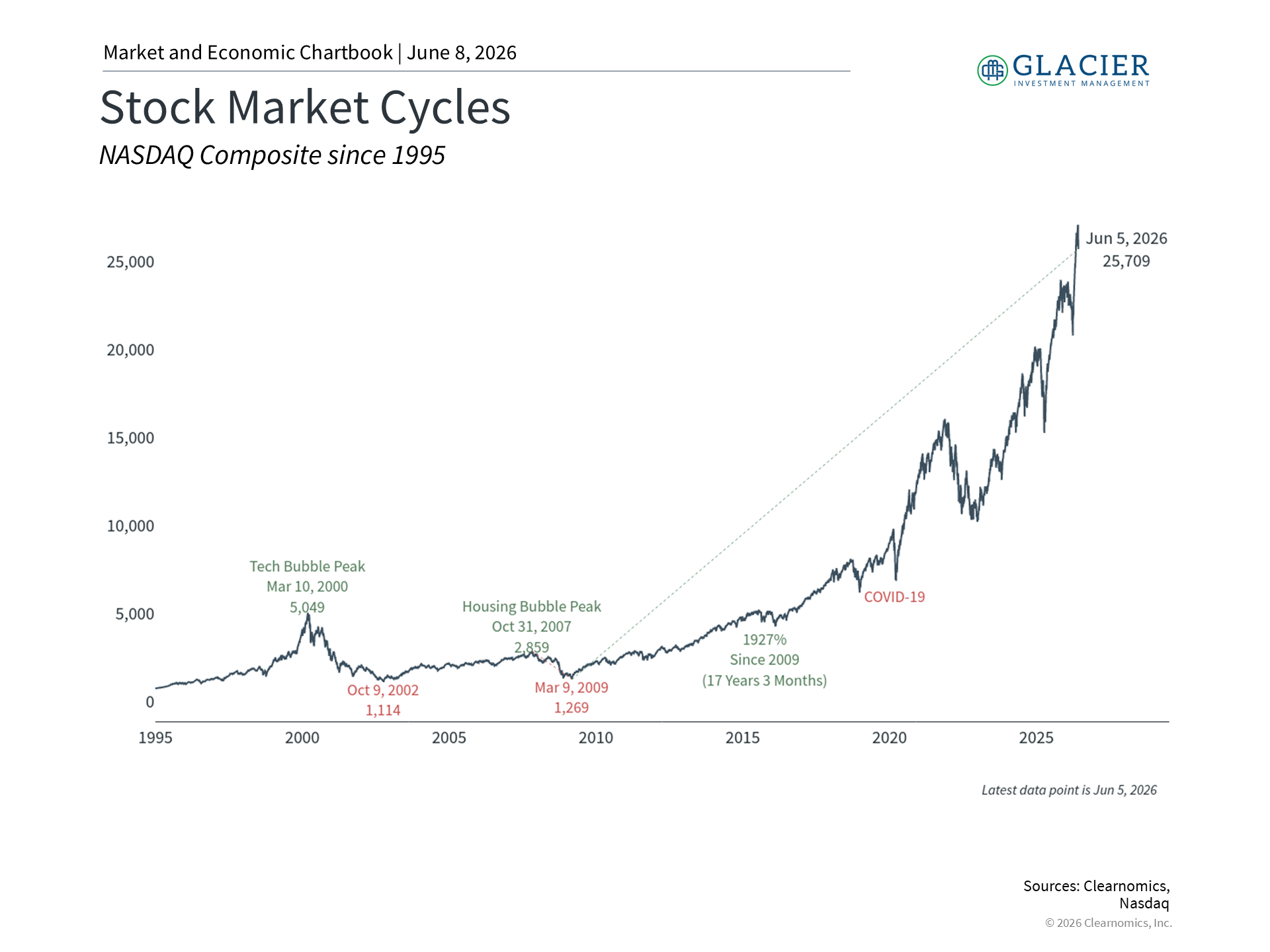
The stock market has experienced historically strong returns over the past quarter, so the latest episode of volatility may raise questions among investors. The Nasdaq experienced its largest single-day fall in a year, with the index declining 4.2% on Friday, June 5. Counterintuitively, the drop followed a strong jobs report, which is good news for the broader economy, because it raises the possibility of a Federal Reserve rate hike by the end of the year.1 At the same time, a brief re-escalation of the conflict in the Middle East added to investor concerns that have been in the background. While it’s normal for the stock market to experience swings, this recent volatility has some clear causes that history can help us understand. Just as architects design buildings to withstand not just sunny days but all types of conditions, investors should remember that periods of strong returns are not a reason to forget about risk management and portfolio balance. While it's important to appreciate when the market performs well, it's during the good times that investors are best positioned to prepare their portfolios for whatever lies ahead. After all, even with the latest one-day pullback, major market indices have still experienced healthy gains this year. History also suggests that investors do not need to overreact to the prospect of Fed rate hikes. There can certainly be short-term volatility as markets anticipate tighter financial conditions, but the stock market has performed well across many different Fed rate hike cycles. Understanding why markets react to interest rates, and keeping these moves in perspective, can help investors stay focused on their long-term goals. The market has experienced renewed volatility
Major indices, including the S&P 500, Dow Jones Industrial Average, and the Nasdaq, have accelerated in recent months. Part of this strength can be described as a “relief rally.” Specifically, the conflict in the Middle East has had less of an economic impact than many originally feared, despite higher oil prices. Corporate earnings have also been strong and there is growing enthusiasm for a wave of upcoming initial public offerings. Perhaps most interesting is the fact that the bond market has faced a more challenging environment as interest rates have remained high. Rates have risen along the entire yield curve this year, with the 10-year Treasury yield, for instance, around 4.5%.2 The bond market is sometimes described as the “smart money,” meaning that bond investors tend to more closely analyze the underlying trends in inflation, growth, and Fed policy compared to the stock market. Whether this is the case or not, the bond market has been signaling that interest rates may stay higher than some had hoped, even as the stock market has rallied. It's not too surprising, then, that the stock market recently reacted to these same developments. This is particularly true for technology and AI-related stocks, which are highly sensitive to interest rates. Technology stocks can be sensitive to interest rates
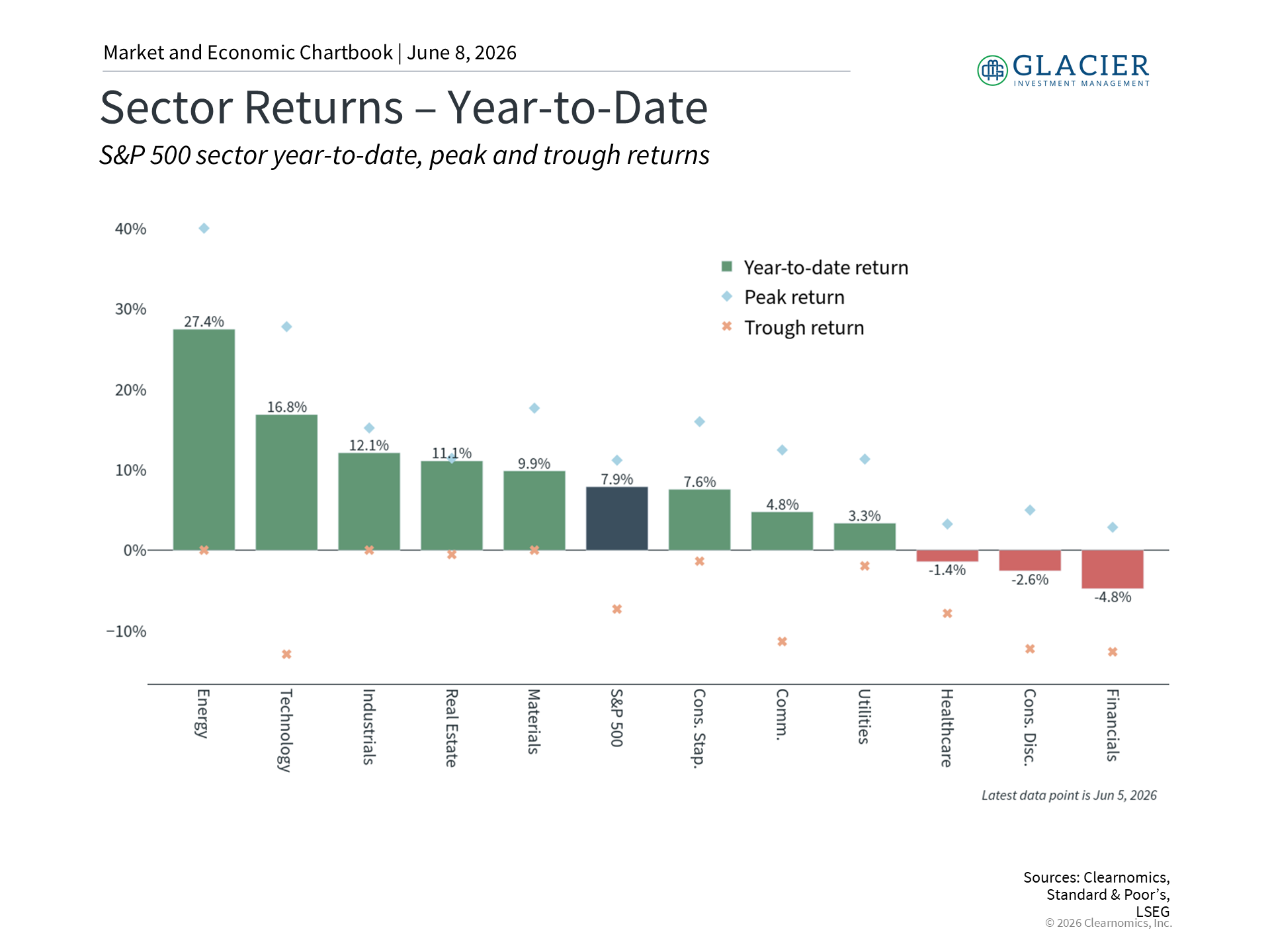
A clear example of this sensitivity is the Magnificent 7, a group of large technology companies. From their peak at the end of 2021 to their bottom in late 2022, when inflation was heating up and interest rates jumped, this group lost about half of its value.3 This affected the value of the Nasdaq as well as broad sectors such as Information Technology and Communication Services. However, these groups then began to recover as rates stabilized and the Fed slowed its pace of hikes, eventually going on to rally to new highs. Why are technology stocks sensitive to interest rates? Investors buy these stocks largely because they expect high growth that extends far into the future, in contrast to more established businesses with steady cash flows. Since interest rates affect how future profits are valued today, even small shifts, especially ones that change direction, can lead to large swings. Thus, interest rates are like a long lever, where even small moves at one end can make a large difference at the other. This dynamic is important because technology-related stocks now constitute a larger proportion of the overall stock market. The Magnificent 7, for instance, now makes up about one-third of the S&P 500.4 Thus, many investors may hold a larger proportion of these companies than in the past. The chart above shows that even with the latest pullback, these sectors have performed well this year. Still, investors may experience periods of volatility they may not have in the past, which is why monitoring asset allocations and maintaining portfolio balance matters just as much when markets are rising as when they are falling. Markets have performed well across Fed rate hike cycles
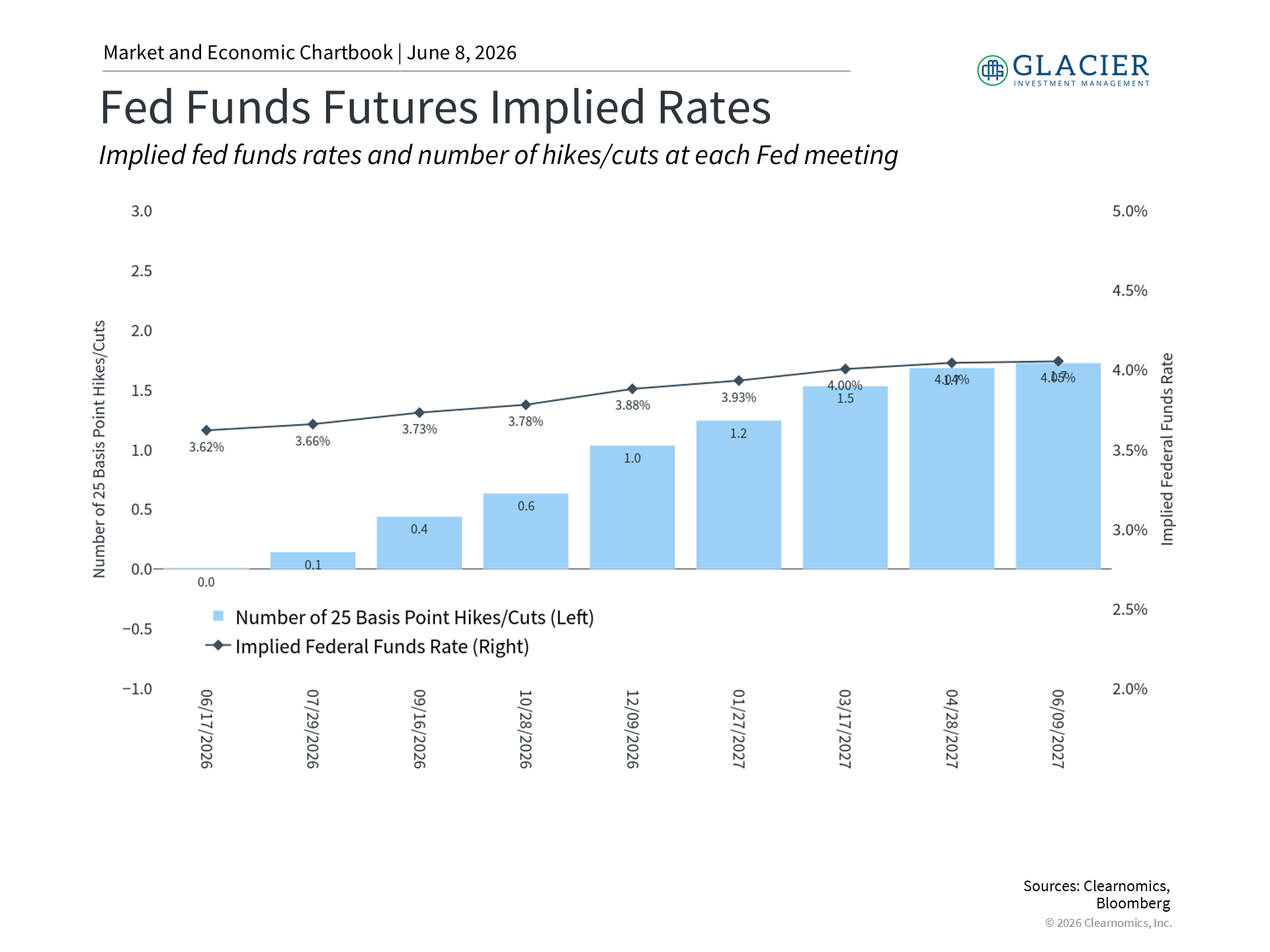
It's important to remember that expectations for Fed policy can change quickly depending on the underlying economic conditions. Earlier this year, the consensus view was that the Fed would continue cutting rates. Those expectations shifted quickly as energy prices rose and the job market strengthened in recent months, as shown in the chart above. This is a reminder that the Fed is often reacting to economic events rather than sitting in the driver's seat. There is also some uncertainty around how Kevin Warsh, as the new Fed chair, will respond to inflation. In the past, he has been viewed as an inflation hawk, meaning he would lean toward raising rates to help stabilize prices for consumers and businesses. This would put him at odds with the White House’s desire for rate cuts. He has also publicly stated that the Fed ought to reduce its balance sheet, which in effect tightens financial conditions. However, all of this remains speculation until the Fed actually makes its decisions based on the actual economic environment. It’s also not yet certain whether this would be the beginning of a rate hike cycle, or simply a short period of tighter rates. That said, even if current market expectations do prove to be correct, the Fed is not anticipated to raise rates until the end of the year, and only by 25 basis points, as seen in the chart above. This is a modest move by historical standards, especially compared to the rate hike cycle from 2022 to 2023, when the Fed raised rates from the zero-lower-bound to 5.25% over 11 hikes. More importantly, the market has performed well across many different rate environments, including periods when rates are rising. This is especially true when the Fed is tightening conditions because the economy is strong, since healthy growth tends to support corporate earnings. In other words, it’s not unusual in rising markets for the Fed to also be raising rates. The Bottom Line Recent volatility reflects the possibility of Fed rate hikes and renewed geopolitical tensions, but neither is a reason to fundamentally change long-term plans. While parts of the stock market may experience short-term volatility, history shows that markets can perform well across many different rate cycles. References 1. https://www.cmegroup.com/markets/interest-rates/cme-fedwatch-tool.html 2. https://home.treasury.gov/policy-issues/financing-the-government/interest-rate-statistics 3. The Magnificent 7 includes Apple, Microsoft, Nvidia, Amazon, Alphabet, Meta, and Tesla. The peak from 2021 to 2022 occurred on November 19, 2021, and the trough occurred on December 27, 2022. 4. Clearnomics research based on Standard & Poor’s data 5. https://www.wsj.com/opinion/the-high-cost-of-the-feds-mission-creep-role-responsibility-monetary-policy-economy-20a352f8 6. https://www.federalreserve.gov/monetarypolicy/fomccalendars.htm#32979 Index Descriptions S&P 500 The Standard & Poor’s 500 Index is a capitalization-weighted index of 500 stocks designed to measure performance of the broad domestic economy through changes in the aggregate market value of 500 stocks representing all major industries. Dow Jones The Dow Jones Industrial Average is comprised of 30 stocks that are major factors in their industries and widely held by individuals and institutional investors. NASDAQ The NASDAQ Composite Index measures all NASDAQ domestic and non-U.S. based common stocks listed on The NASDAQ Stock Market. The market value, the last sale price multiplied by total shares outstanding, is calculated throughout the trading day, and is related to the total value of the Index. | |||
Making Sense of Recent Market Volatility