With the November midterm election approaching, campaigns are starting to intensify across the country. Politics have only grown more divisive in recent decades, so it’s natural for investors to wonder whether the election should influence their financial decisions. More than ever, it’s important to separate our political views from investing, and not vote with our portfolios and financial plans.1 Midterm elections occur every four years at the halfway point between presidential election cycles and help determine the composition of Congress. Current polls suggest that the likely outcome is a divided government, but margins are thin in both chambers, so a lot can change in the coming months.2 In the House, 218 seats are needed for a majority and Republicans currently control 219 seats, so Democrats could win control with only a few races. In the Senate, Republicans have a firmer hold with 53 seats, but expectations in prediction markets have been shifting.3 As citizens, voters, and taxpayers, there is nothing more important than elections. This is because elections shape the direction of policy on issues including entitlement programs, taxes, and the federal debt. However, this doesn’t mean investors should get caught in the details. History shows that Washington politics matter far less to long-term portfolio outcomes than many might believe. Why is this, and how can investors stay focused on the long-term as the election season heats up? Midterm years have been positive on average
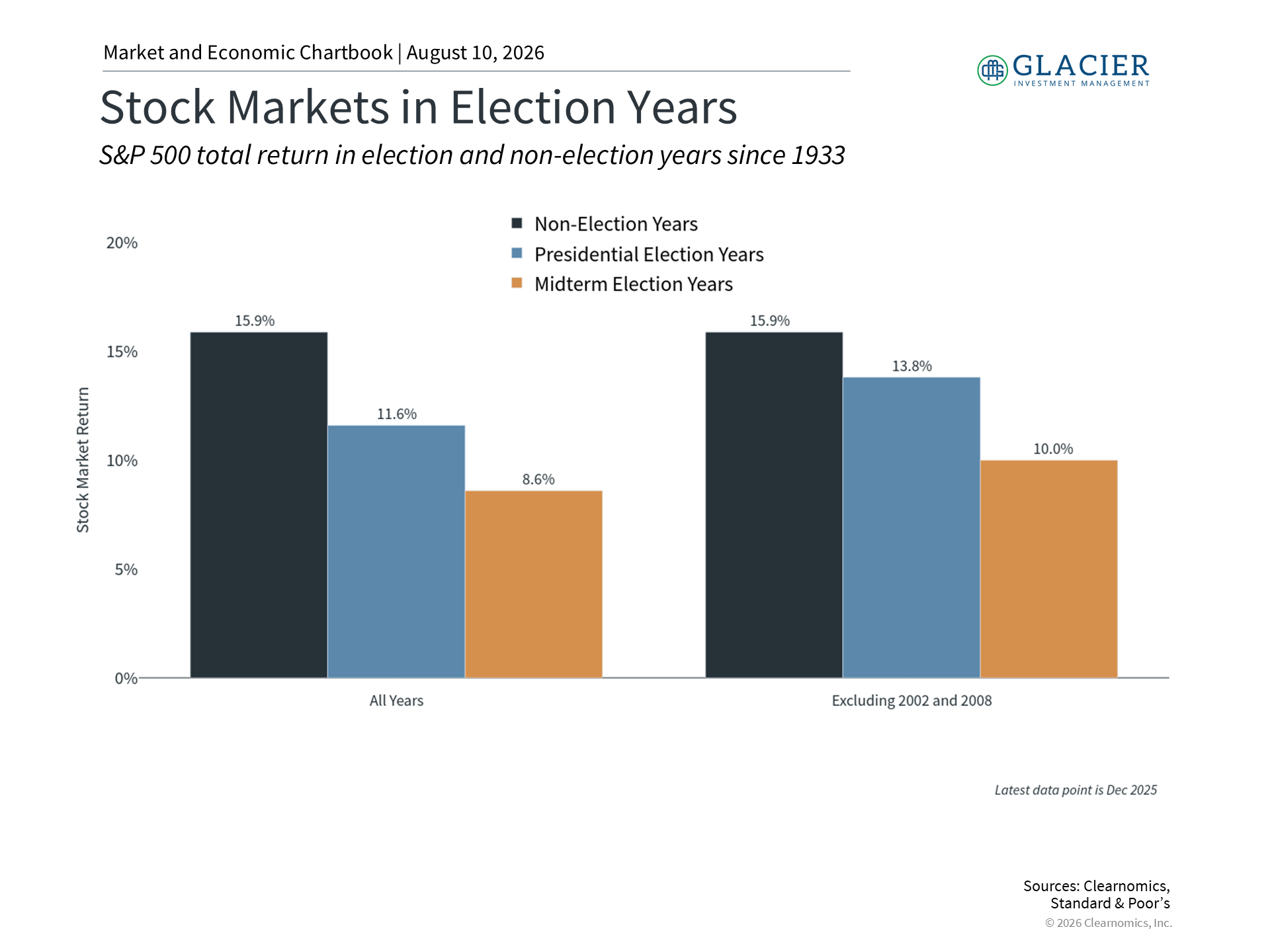
It seems natural to believe that politics should impact the stock market, and that investors may want to avoid election years altogether. Since elections affect economic policies, which in turn impact industries and companies, it’s easy to assume that election years may simply be more volatile. However, history shows that this isn’t the case. The accompanying chart highlights the fact that returns have been positive across different types of election and non-election years going back to the Great Depression. While there is natural variation between the averages of these types of years, markets have performed well under Republicans, Democrats, and divided governments.4 This does not mean that all years are positive. Each period was driven by a unique set of circumstances depending on the phase of the business cycle. Recent midterm election years, for instance, include 2022 which experienced significant inflation in the wake of the pandemic, and 2018 when many worried about global growth and Fed policy. In both cases, returns were negative due to the underlying trends, not because they happened to be midterm election years. Similarly, longer-term market trends often have little to do with politics. This includes the information technology revolution that began in the 1990s, the housing boom and bust of the mid-2000s, the inflationary impact of the pandemic after 2020, and today’s AI innovations. Each of these periods influenced markets in important ways that had little to do with the White House and Congress. It’s also common for a president who starts with a majority in Congress to lose it during a midterm election. In recent decades, this was the case for President Biden during his single term, Obama during his first term, George W. Bush in his second term, Clinton in his first term, and more. There are many reasons for this that have been studied by political scientists, including changing voter preferences and psychology two years into a four-year presidential term. Regardless of the exact causes, both markets and the economy have grown steadily over these decades. The economy affects portfolios more than elections
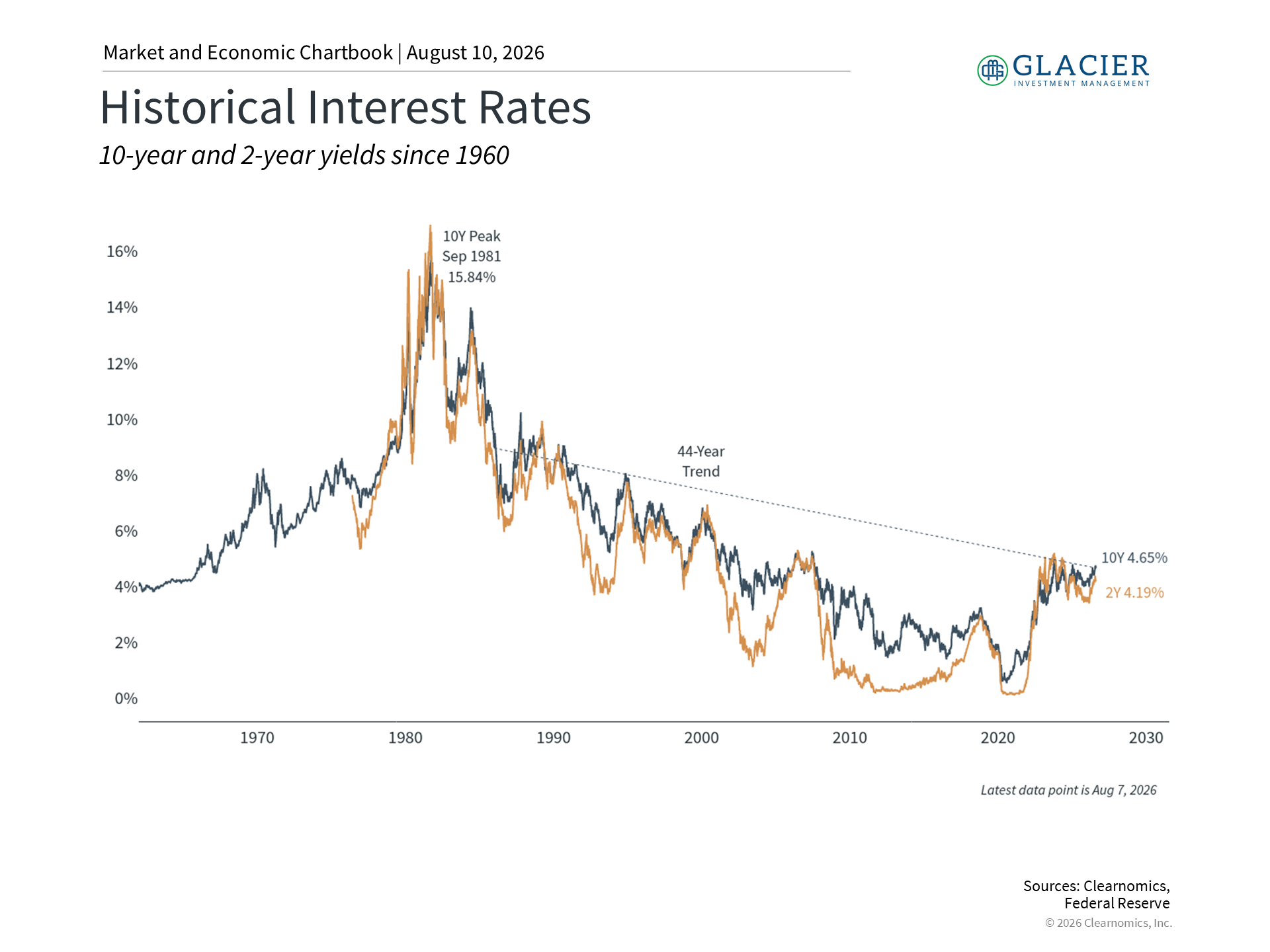
For long-term investors, the business cycle and interest rates have historically been far more important drivers of markets and portfolios than who controls the White House or Congress. The chart above highlights the current period of elevated rates affecting markets, businesses, and consumers. While interest rates can be influenced by policymakers, they are ultimately determined by longer-term trends. This matters because political change usually occurs incrementally and with lags. The fact that majorities in Washington are difficult to sustain reflects the design of our political system. Even when there are shifts in policies that appear significant, such as with taxes and tariffs in recent years, they often don’t have as large or as immediate an effect, positive or negative, as some might predict. This is because the pace of economic growth, corporate earnings, inflation, and jobs are influenced by many other important factors. This year's election is taking place against a backdrop of geopolitical conflict, inflation, AI concerns, and more. These factors have been far larger drivers of markets, corporate earnings, and interest rates than the specifics of each Congressional race. And yet, major stock market indices have generated double-digit returns despite short periods of uncertainty. So, while the midterm election happens to be taking place this year, it’s important to focus on the broader environment. Markets have grown across both political parties
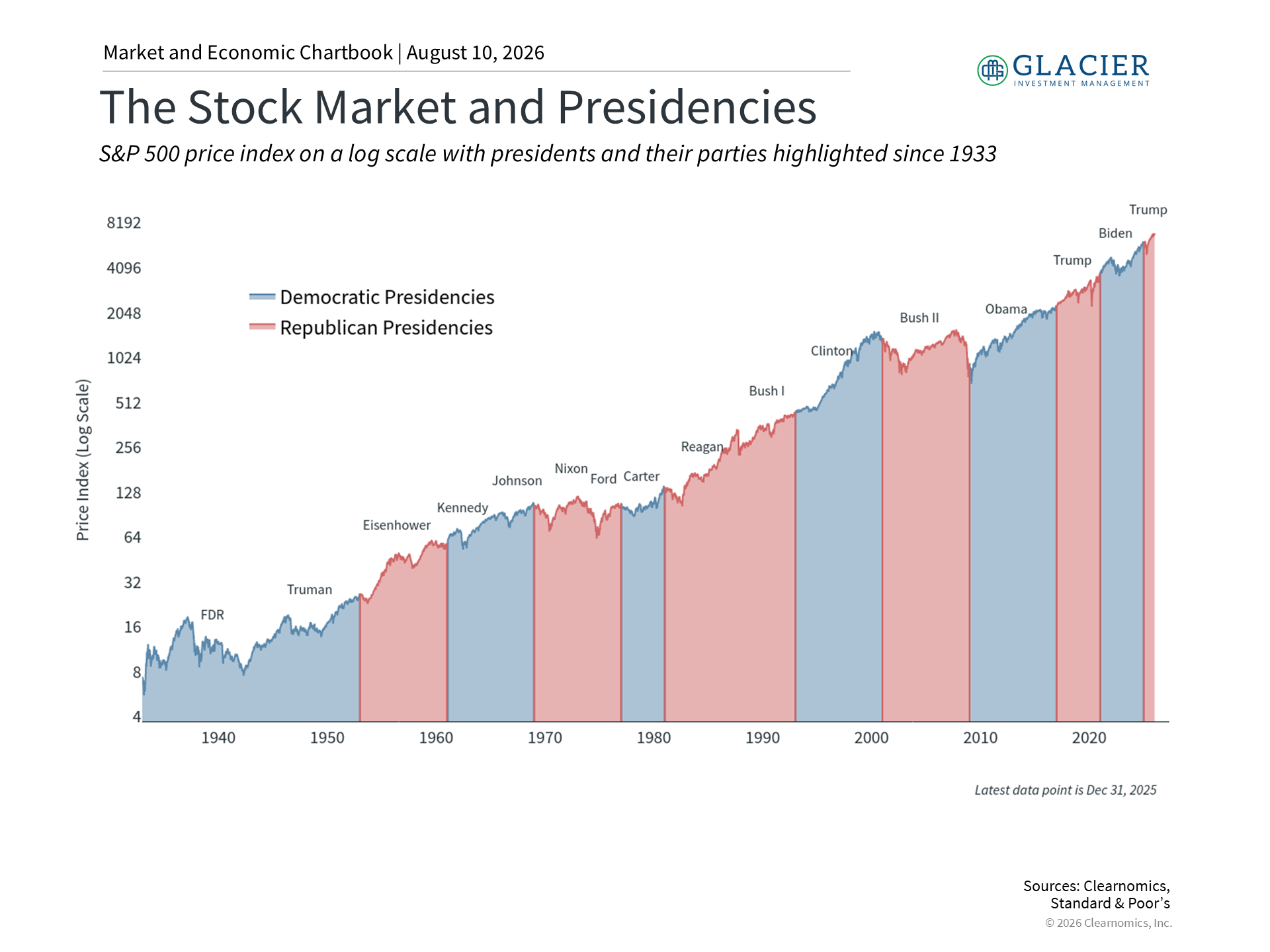
Perhaps the most important perspective for long-term investors is that markets have performed well across many different political cycles. The accompanying chart shows that the S&P 500 has grown over the past century, spanning political periods, wars, recessions, policy shifts, and everything in between.5 This does not mean that policy isn’t important or that the stock market doesn’t experience volatility. Debates around tax rates, defense spending, and the federal debt could have real consequences for the economy over time. Today, the outcome of the election could influence the legislative agenda, including the trajectory of the Iran conflict, tax provisions, tariffs, and the national debt. These are issues that many investors care about. However, the key is to distinguish between what we can and cannot control when it comes to our portfolios and financial plans. It’s important for voters to make their voices heard, but not with their hard earned savings. Instead, holding a portfolio designed to perform across a range of economic and political environments is more important than trying to predict the result of a single election. The Bottom Line Midterm elections are important for the country, but it’s important to separate politics from investing. History shows that, even during election years, staying disciplined and focused on fundamentals is the best way to achieve financial goals. References 1. https://www.usa.gov/midterm-elections 2. https://www.realclearpolling.com/latest-polls/2026 3. https://polymarket.com/event/balance-of-power-2026-midterms 4. Clearnomics research and Standard & Poor’s data, as of August 7, 2026 5. Clearnomics research and Standard & Poor’s data, as of August 7, 2026 Index Descriptions S&P 500 The Standard & Poor’s 500 Index is a capitalization-weighted index of 500 stocks designed to measure performance of the broad domestic economy through changes in the aggregate market value of 500 stocks representing all major industries. The modern design of the S&P 500 stock index was first launched in 1957. Performance prior to 1957 incorporates the performance of the predecessor index, the S&P 90. | |||
The Midterm Election and Long-Term Investing